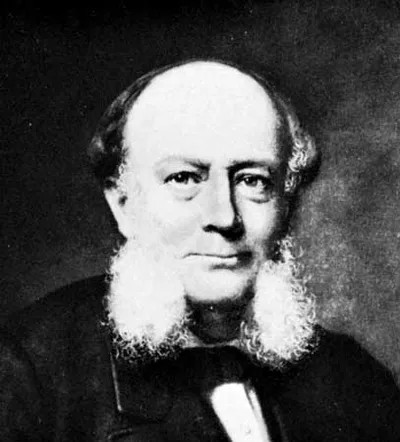
Sir William Siemens didn’t just invent things. He changed how we make steel and how we talk to each other across oceans. Born in Prussia in 1823, he died in London in 1883. A lot happened in those sixty years. Most of it involved heat, wires, and money.
From Banker to Inventor: Why He Left Germany
He was supposed to be a banker. His uncle wanted him in the family business in Lübeck. Then his brother, the famous Werner Siemens, said engineering was a better fit. So William went to technical school in Magdeburg. He studied chemistry and physics at the University of Göttingen. Free tuition. His brother pulled strings.
He needed capital. So he sold Werner’s electroplating process. First in Hamburg. Then London. He arrived in March 1843 with almost no money. He sold the rights to Elkingtons of Birmingham for £1,600. That was the seed money.
He came back to England in 1844. The patent laws there looked promising. He stayed.
How the Open-Hearth Furnace Changed Steelmaking
Here is the big one. The open-hearth furnace.
Before this, the Bessemer process was king. It was fast. But it wasn’t precise. William had an idea starting in 1847. He and his brother Friedrich looked at waste heat. Why let it escape? Capture it. Use it to heat the air going into the furnace. This is the regenerative principle.
In 1861, he patented it. The furnace used gas from low-grade coal. It was first used in glassmaking. Then steel. It worked better than Bessemer. It allowed for better quality control. Eventually, it replaced the old method. This invention alone made him a household name in industry.
He didn’t just patent it. He built a steelworks in Landore, South Wales, in 1869. It made money for a while. By the 1880s, though, he was losing cash. Running a factory is harder than inventing the technology.
The Telegraph Empire and Undersea Cables
William wasn’t just about fire and iron. He loved wires.
He acted as the English agent for his brother’s firm, Siemens & Halske, from 1850. In 1858, things got serious. He became the managing partner of a separate London firm under the same name. They tested cables. They made apparatus.
The results were massive. In 1874, they laid a cable from Rio de Janeiro to Montevideo. In 1875, they laid the first direct link from Britain to the United States. That is not a small feat. It connected continents.
Early Water Meters and Electric Light
Before the steel fame, there was the water meter. He invented it in 1851. It earned him large royalties. This is how he paid for his life in London. An office in the city. A house in Kensington. He lived there with his brothers Carl and August Friedrich.
He married Anne Gordon in 1859. She was the sister of a professor at the University of Glasgow. That same year, he got British citizenship.
He didn’t stop there. He looked at electric lighting. He improved arc lights. You could see them at the British Museum. A few months before he died, he was involved with the Portrush electric railway in Northern Ireland. One of the earliest examples of electric traction.
Recognition and Legacy
Did he get his due? Yes.
He joined the Institution of Civil Engineers in 1860. The Royal Society elected him a fellow in 1862. He presided over the British Association for the Advancement of Science. He got honorary degrees. He got knighted in 1883, the year he died.
He left a large fortune. No children. But the infrastructure he helped build remains. The open-hearth process defined steelmaking for decades. The telegraph networks changed global communication.
Sir William Siemens is often overshadowed by his brother Werner. But look closer. The patents. The factories. The cables. William did the heavy lifting in Britain. He turned ideas into industry.
The steel mills are quiet now. The old cables are gone. But the pattern he established—inventing, patenting, building—is still how tech scales. He proved that you need more than a clever idea. You need to sell it. You need to manufacture it. And sometimes, you need to move to a country with better patent laws.