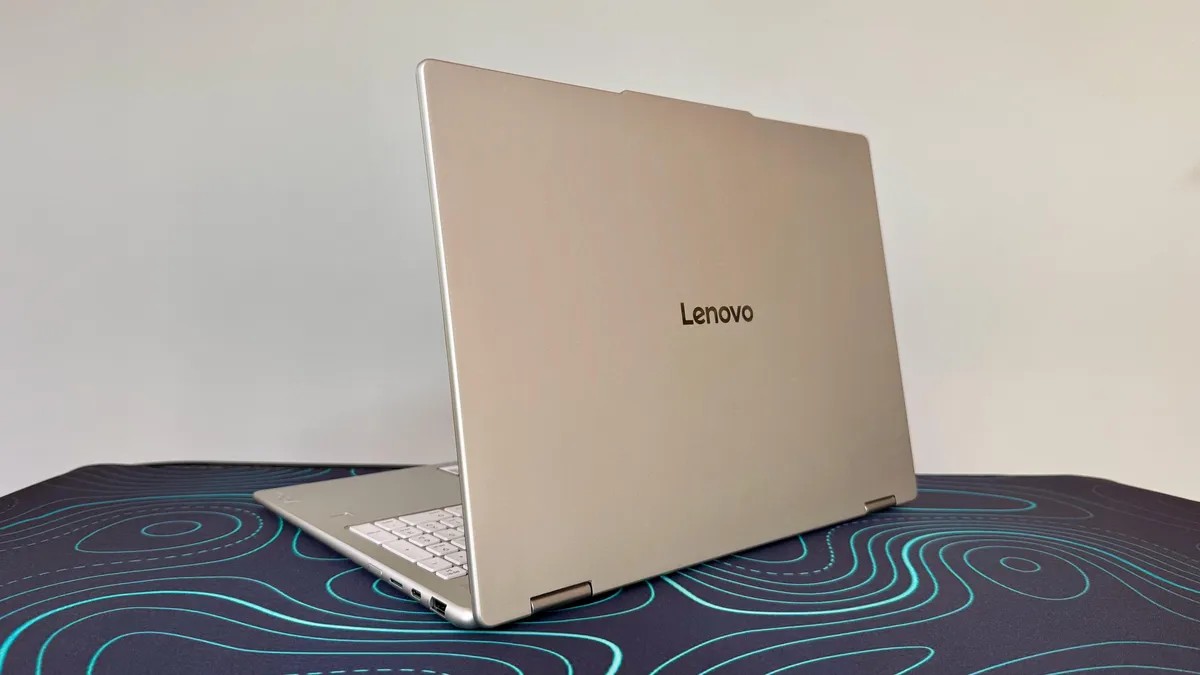
Lenovo wants you to believe you can have your cake and eat it too. They built the Yoga 7A 2-in.1 16 to sit squarely in that messy middle ground for creators and students who refuse to pay workstation prices but also refuse to accept mediocre screens. The $1,790 config I tested—loaded with AMD’s Ryzen AI 7 425, 24GB RAM, and a 1TB drive—is positioned as a prosumer dream.
Is it? Sort of.
The Good: Screen Real Estate, Mostly
The 16-inch OLED panel is the star here. It’s gorgeous. Colors pop. Blacks are truly black. For photo editing or watching Netflix, it feels like an upgrade to every laptop you’ve owned since 2018. AMD’s new chip keeps Windows 11 snappy, even when I had forty browser tabs open and a PDF editor fighting for resources. It just works.
The battery life surprised me, too. It lasted fourteen hours in our YouTube drain test. That is genuinely impressive for a massive OLED slab. The 3.95-pound weight is heavy enough to notice if you carry it up a flight of stairs every day, but lighter than the Dell or HP equivalents. You’ll want to lug the tiny 65-watt USB-C charger around because, yes, the ports are only 10Gbps USB-C. No Thunderbolt. No USB4. Just standard, slightly sluggish USB.
The Bad: Dim Lights, Weak GPU
Then you look at the brightness. 286 nits. In direct sunlight? Forget it. The display tops out below 300 nits, making it a terrible choice for HDR content or bright conference rooms. OLED doesn’t need high nit counts to look good due to infinite contrast ratios, but reality intrudes here.
The integrated Radeon 740M graphics chip is where the dream starts to unravel. This machine is ill-equipped for 3D work. Serious video editing lags. AAA gaming? It luggers. I ran it through the wringer and the GPU trailed behind Intel’s integrated options in synthetic tests. Indie games run fine at 108p if you tinker with settings, but don’t bring this to an Esports tournament.
Why buy a laptop with no discrete GPU options if you care about performance? You don’t. If you can skip the 360 hinge, the Asus Zenbook A18 or Acer Swift 800 offer better power for similar cash.
Build and Input: Quirks Abound
It’s metal and plastic. Feels premium. The hinge is buttery smooth, shifting effortlessly from laptop to tablet. It looks professional enough for a boardroom but playful enough for a classroom.
The keyboard is odd.
Key travel is crisp. Layout feels spacious. Yet I found myself smashing Num Lock every time I went for Backspace. A weird design choice that frustrated me for hours. The trackpad is standard mechanical, large, and accurate, lacking the modern haptic buzz of newer models.
And the camera? Surprisingly excellent. 1080p with good mic noise cancellation. It actually produces a sharp image for Zoom calls. Most laptops shame their cameras on this price tier. Not this one.
The OLED is stunning for sRGB work, but the brightness cap and lack of discrete graphics limit its utility as a primary creative workstation.
So, Should You Buy It?
Only if you love convertible tablets.
If you need that screen to flip backward and rest in a tent mode, the Yoga 7a is the king of budget OLED convertibles right now. The start price dips to $120 for the lower-spec model, and the OLED version discounted to $1450 while I waited. But here is the truth: this machine lacks the raw power for heavy creative lifting. It struggles with sustained loads. It gets warm under the keyboard deck. It’s a productivity machine first, a creator’s tool second.
The question isn’t whether it’s fast. It is fast enough.
The question is whether you value the flexibility of the 2-in-1 form factor enough to sacrifice graphics performance. If you render 4K video daily, look elsewhere. If you stream videos and write papers, you’ll likely forget how much power you’re missing until you try to launch Cyberpunk 2077. Then you’ll wonder why Lenovo locked you into integrated graphics in the first place.
The Yoga 7A lives in that limbo space. Comfortable, colorful, but ultimately unable to carry the heaviest loads you might expect from a machine of its size and price tag.
Maybe that’s enough. Or maybe it’s a compromise that feels too costly when the clamshell alternatives exist. The market hasn’t decided. Neither have I. 🤔