Amazon bought Bee. They added features. I wore it.
The thing sits on your arm like a smartwatch that gave up on telling time. It records. Transcribes. Summarizes. Essentially a pocket-sized stenographer for the chronically disorganized. Sync it to your calendar, get alerts. Forget nothing.
It sounds efficient.
It sounds like surveillance.
Setting it up is trivial. Click the button. A green light blinks—yes, it is listening. When the light dies, so does the recording. The app chugs through the audio, spits out a summary. Done.
But here is the rub. I care about privacy. Not the performative kind, but the real, sweating-under-the-heat kind. In an age where algorithms know my shopping habits better than my mother, I don’t really want another device eavesdropping on my existence 24/7.
So I tried it anyway.
Because I’m curious.
Because technology demands sacrifice.
Professional competence, personal unease
Bee works.
Really well, even.
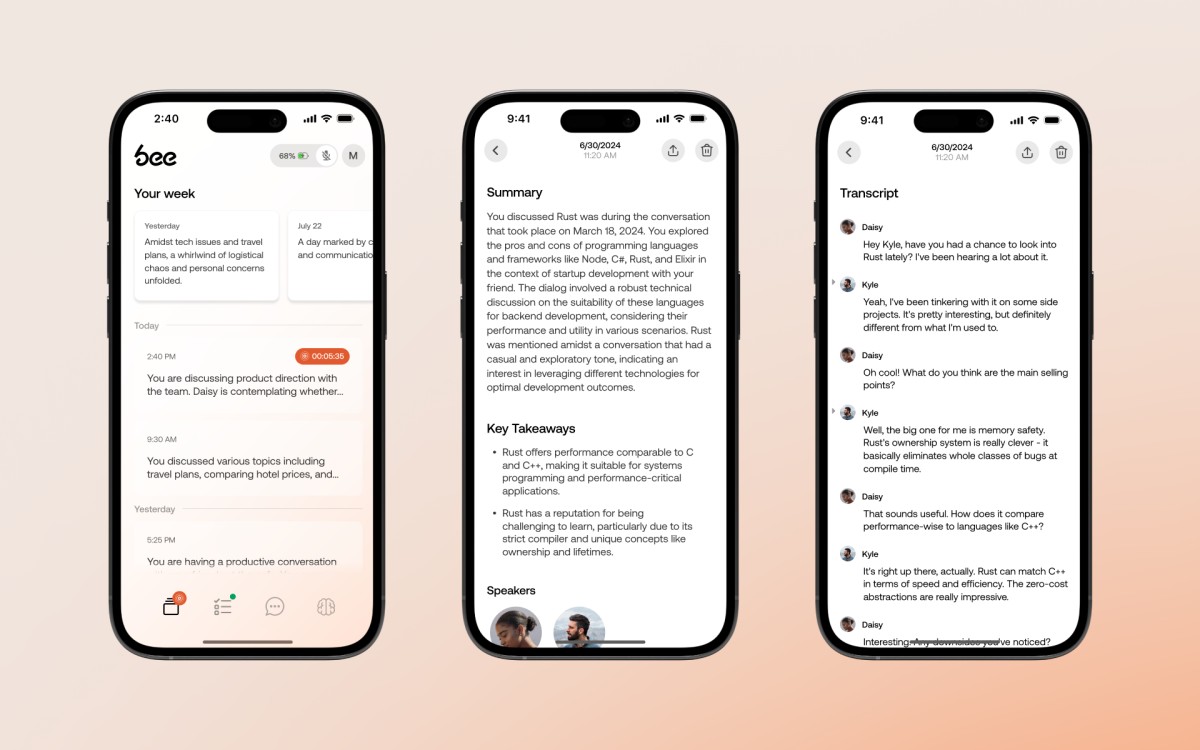
I used it on a business call. Asked for permission first. Obviously. The result was clean. A structured summary that let me skip re-listening to twenty minutes of talk about Q3 deliverables. Helpful? Yes. Revolutionary? No. Otter does this. Granola does this. But wearing the capability is different. You keep the device on all day, let it run in the background, catch what you missed without lifting a finger.
For a calendar stacked with meetings, this is genuinely useful. A professional crutch.
Then came movie night.
I wore Bee while watching Reservoir Dogs with friends. I worried. Would it panic at the vulgarity? Misinterpret the on-screen violence as actual danger?
It didn’t.
Instead, the smart wearable processed the chaotic dialogue, contextualized the scene, and labeled the interaction as “Tarantino Film Scene Analysis.”
Impressive.
Slightly terrifying.
The wearable understood we were analyzing film. It just didn’t seem to understand that I wanted it to stop.
Here is where the transcript falls apart.
Summaries are neat.
Transcripts are messy.
Bee doesn’t know who is speaking half the time. You have to manually tag speakers. It misses chunks of conversation. Not huge gaps, just enough to feel incomplete. A messy draft rather than a finished product.
The privacy bargain
And here we land on the actual cost.
To do all this, Bee wants keys to the castle. Not just audio.
It wants your location.
Your photos.
Contacts.
Calendar.
Health data, if you want to get creepy with sleep patterns.
This is not a gadget for the shy.
To function, Bee needs expansive access to your life. Both digital and offline. All this data? It lives in the cloud. Bee’s answer is encryption. They claim robust audits, technical safeguards, “state of the art” protection. Standard corporate poetry.
Does it work? Usually.
Can Amazon protect everything? Probably not.
They are the house of clouds. When clouds leak, we drown.
Bee did tease a fully local version. A device that processes audio without sending it to a server. Becca Farsace reported seeing the demo. It would change everything.
Amazon has stayed quiet on that front since.
Left hanging
So where does this leave us?
As a tool? A strong contender. A digital secretary that catches your drift, even when you are half-asleep in a boardroom.
As a lifestyle choice? A stretch.
Wearing it feels like wearing a wire. Even if it’s your wire.
Even if the encryption is strong.
The convenience is real.
The unease is real.
Which one do you value more?
Or do we just want the data too bad to ask the question?