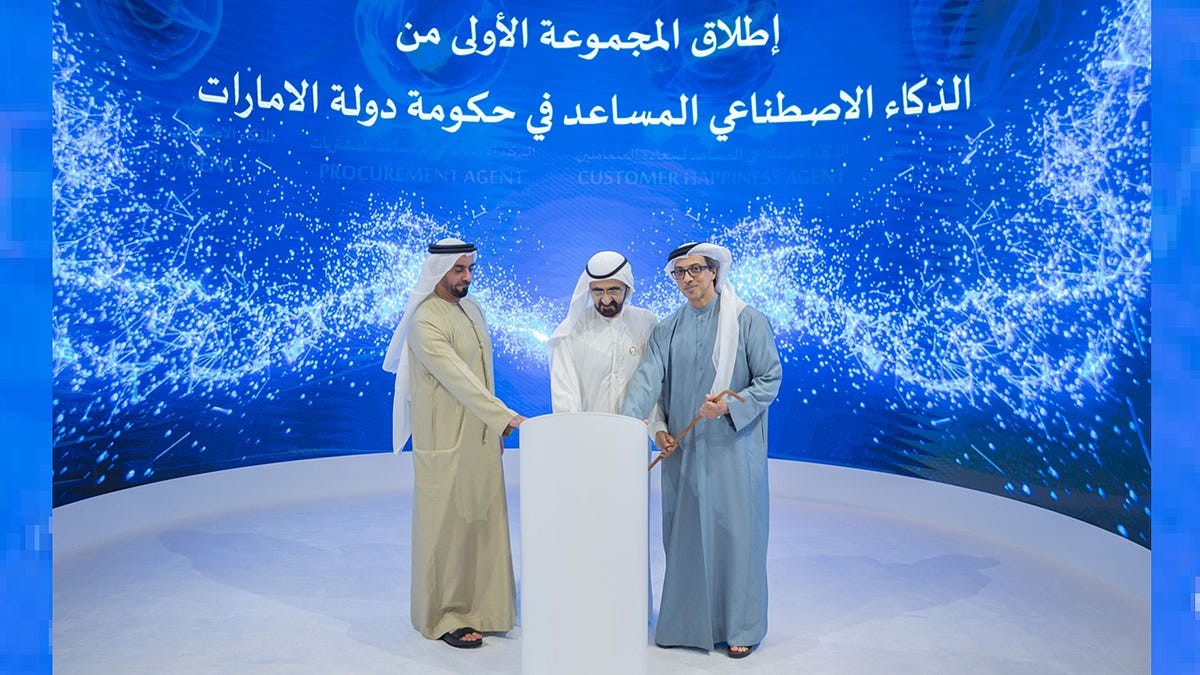
Abu Dhabi hosted its first national Agentic AI Retreat this week. The VIPs were there, of course. His Highness Sheikh Mohammed bin Rashed Al Maktoum attended alongside four hundred ministers, federal leaders, and officials. The crowd watched the UAE Government launch its first cohort of AI agents. Four specific ones. They handle procurement. They do tax audits. They monitor customer happiness. They fix technical glitches.
It is a pivot.
The program has moved past the theoretical stage. No more frameworks. No more training exercises. Now? Operational deployment. The target is ambitious, to say the least. Half of all government services need agentic AI integration. The deadline? Two years.
Why it matters
This launch is the moment the rubber meets the road for UAE’s agentic transformation. It becomes tangible. Measurable.
Each of the four new agents targets a high-volume function. Where impact counts. Where you can track autonomous AI execution directly against real-world performance. By embedding agentic AI into public services, the UAE is positioning itself. It wants to be the global model for an AI-driven government. Is anyone else trying that fast? Probably not.
The Four Agents
The keynote came from H.E. Dr. Sultan Ahmad Al Jaber, who serves as Minister of Industry and Advanced technology and ADNOC CEO. He laid out the specs for the four newcomers:
- Procurement AI Agent : It streamlines sourcing. It optimizes workflows. The goal is speed and efficiency for procurement teams.
- Tax Auditing AI Agent : Built for data verification and tax reviews. It aims to improve compliance. Faster audit turnarounds. Better quality outcomes.
- Customer Happiness AI Agent : It gives service agents instant access to info. Faster responses. Better citizen experience. Simple cause and effect.
- Technical Support AI Agent : Manages IT services. Helps tech teams solve system issues. Ensures business continuity for digital government services.
ADNOC provided the proof of concept. Dr. Al Jaber shared numbers that are hard to ignore. The energy giant deploys over 110 AI agents right now. Across HR. Finance. Procurement. Auditing.
They have trained twenty thousand employees to build job-specific AI models. Three thousand are in daily use. Agentic AI utilization? Eighty percent organization-wide.
Omar Sultan Al Olama, the Minister of State for AI, framed it as a competitiveness issue. A global one.
“Early adopters lead,” he suggested, positioning agentic AI as a tool for topping global governance rankings.
The broader picture
Over four hundred leaders gathered to present executive plans. They focused on use cases. Integration across all facets of federal work. It wasn’t just about code, either.
The sixth cohort of the Federal Artificial intelligence Programme graduated during the retreat. A reminder that human capability matters alongside the machines.
The foundation for all of this was poured in late April. On the 23rd, the UAE Cabinet approved a framework. The first of its kind, globally.
The directive is clear: deploy agentic AI across fifty percent of government sectors and operations in twenty-four months.
A dedicated task force now exists. Chaired by H.E. Mhammad Abdullah Al Gergawi. Overseen by H.H Sheikh Mansour bin Zayed An Nahyan. Ministers and directors general are on notice. They will be assessed. Speed matters. Capability matters.
This fits into a wider strategy. An AI-powered Proactive Govemment Performance System sits alongside it. AI embedded into strategic planning for thirty-eight entities. A regulatory intelligence ecosystem that could accelerate law-making by seventy percent.
The government is changing how it thinks. How it acts.
Whether it sticks? We’ll see in two years.