我们将联系人列表中的一串数字视为咒语。 拨打它,就会建立连接。 但这些数字不是随机的。 它们是一个地理地址,其功能很像计算机的 IP 地址。 该地址的长度根据您所在的位置而变化。 在小城镇,您可能会使用五位或六位数字。 在主要的大都市中心,这个数字会增加到十个或更多。
American 10-digit standard
The fixed-length format is used in the United States. 10 digits. every time. This consistency is a legacy of the late 1940s. AT&T created the North American Numbering Plan (NANP) to make long distance calls less painful for both carriers and users. This system started operating in 1951.
The structure is rigid. A 3-digit area code followed by a 7-digit local number. The standard format is: NXX-NXX-XXXX.
-
Area Code : Regulated by the Federal Communications Commission (FCC). They indicate a specific geographic area, usually a part of a city or state. The original area code 86 dates back to 1947 and was set up to maximize the efficiency of the original rotary dialing system.
-
Prefix : This central block meant something very physical. This identifies the specific central office switch to which the line is connected. Each switch has a unique three-digit identifier. Computers replaced mechanical switches and Local Number Portability (LNP) arrived. The prefix no longer determines which switch handles the call. It still shows your location to the city level, but the physical hardware it once displayed is largely obsolete.
-
Line number : The last four numbers indicate a specific line. These are assigned to lines, not devices. Therefore, you can replace your iPhone with an Android device without changing your number. The wiring remains the same. The hardware is not.
Think of this as a physical address. The area code is the city. The prefix is street. The row number is the house.
Cross border calls
The telephone network connection is disconnected when the connection leaves the NANP system. You must first dial 011 (International Access Code ). Next is the country code.
Calls from the US to Canada and most Caribbean countries are not included. Usually you skip the 011 prefix entirely. Some countries require an area code in addition to the country code. They appear after the country code and before the local subscriber number.
了解区号耗尽和覆盖计划
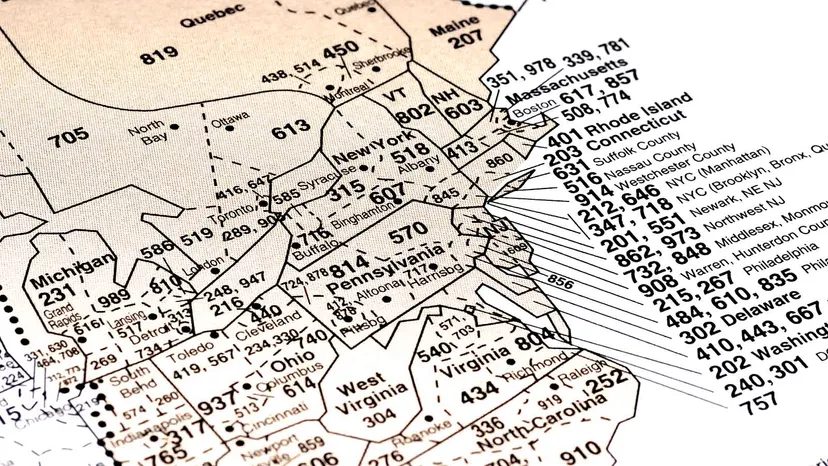
The US telephone network is a crowded place. We are currently juggling almost 350 geographic area codes alongside 25 non-geographic ones and several others sitting in the pipeline, waiting for activation. California holds the crown for the most active codes, sporting 36 distinct prefixes. That is a lot of digits to keep straight.
The original numbering plan from the 1940s assumed a static world. Carriers were handed blocks of 10,000 numbers for a specific region. For small towns, that was plenty. Large cities? Maybe less so, but the system held together. Then the 1990s hit.
Cell phones exploded onto the scene. Suddenly, everyone needed a number. The internet arrived. VoIP services popped up. Cable companies started offering voice services. The demand for unique identifiers skyrocketed. The old model of assigning massive blocks of numbers to single carriers in single regions couldn’t handle the volume.
Why overlays replaced splits
For decades, the solution to number exhaustion was a geographic split. You would carve an existing area code in two. The most populous urban centers usually kept the original code. Everyone else, often in the suburbs or rural outskirates, got reassigned to a new prefix. It was disruptive. People had to update their voicemail greetings, reprogram their speed dialers, and explain the change to anyone who called them.
Then came the overlay area code strategy.
Instead of drawing new borders, overlays stack new codes on top of the exact same geographic region as the existing ones. The same house might have a neighbor with the old code and a new neighbor with the new one. It preserves history but increases capacity.
There is a catch. Overlays forced the end of seven-digit dialing for local calls. You can no longer just punch in the last seven digits. You must dial the area code first. This is 10-digit dialing. It is now the standard for every single city in the United States.
Take Georgia as an example. The original 404 code launched in 1951. As Atlanta grew, it needed more numbers. The state added 770, then 678, and later 470. Each was an overlay on the 404 territory. In March 2022, the Georgia Public Service Commission approved yet another overlay: 943 for metro Atlanta. But don’t expect to see it in your contact list immediately. Carriers only assign 943 numbers when the pools for 404, 678, 770, and 470 are completely drained. It is a buffer strategy.
The 988 transition
The push for 10-digit dialing reached a critical mass in May 2022. The Federal Communications Commission designated 988 as the three-digit code for the National Suicide Prevention Lifeline.
This wasn’t just about adding a new service number. It was a technical necessity. Thirty-five states had 82 area codes where the local exchange began with 988. If someone dialed 911 for an emergency or 988 for mental health support, the network needed to distinguish between a seven-digit local call and a three-digit shortcut.
The FCC mandated that all these regions switch to mandatory 10-digit dialing. The old way of thinking—that you could dial short codes and seven-digit numbers locally—died that day. Starting July 16, 2022, dialing 988 routes directly to the lifeline. It works just like 911. It is universal. It is immediate.
Breaking down the digits
If you are trying to make sense of a US phone number, the structure is rigid. Take (555) 555-1234.
The first three digits are the area code. This identifies the general geographic region. It is unique to that area, though overlays mean multiple codes can now serve the same zip code.
The next three digits are the exchange or central office code. This narrows the location down further, often pointing to a specific switch or neighborhood.
The final four digits are the line number. This identifies the specific subscriber station.
So, what is a phone number at its core? It is a sequence of digits that bridges the gap between callers in different regions. It connects you to a fixed-line subscriber station, which is then linked to either a traditional copper wire or a wireless mobile device.
Do cell phones appear in directories? Generally, no. They are private by default. Unlike landlines, which often had to be listed for service reliability, mobile numbers are opted-in or hidden entirely. You won’t find them in the yellow pages. You won’t find them in most public directories. They belong to the individual, not the location.