
We live in an era where the internet has rewritten the rules of human connection. Twenty years ago, swapping a movie or an album with someone on the other side of the planet was science fiction. Today, it is mundane. This capability is file sharing. And while Napster started the fire in the late ’90s, it was Kazaa that built the inferno.
Napster died under the weight of copyright lawsuits, eventually rebirthing as a legitimate pay-per-download service. But a more aggressive, wider-reaching beast emerged shortly after. Kazaa took the mantle of the internet’s most popular file-sharing network. It didn’t just share music. It moved movies, TV shows, and digital data at a scale that dwarfed its predecessor.
So, how did this network function? And why has it survived when so many legal giants tried to crush it?
What Actually Is Kazaa?
Developed in March 2001 by programmers Niklas Zennström and Janus Friis, Kazaa was born out of a Dutch company called Consumer Empowerment. The vision was simple: an open forum. Users could upload anything. Movies. Books. Games. It was a place to share content you created, sure, but also content you had bought or found elsewhere.
That “found elsewhere” clause is what got everyone in trouble.
When American music labels and movie studios realized what was happening, they sued. The pressure was immediate. Zennström and Friis stepped back. They shut down their operations and transferred ownership to Sharman Networks Limited, a company based in the South Pacific.
The leadership changed. The code stayed. And the users kept coming.
Despite the legal storms, Kazaa remains a thriving entity. It is not just a relic of the early web. It is a massive, active infrastructure. When you download the software, you aren’t just getting a search bar. You are tapping into a global exchange engine.
The User Experience and Scale
The mechanics of using Kazaa are deceptively simple. You type a title. You hit search. The results pour in.
But the scale is where the technology gets interesting. A single search can pull up as many as 3,000 results. This isn’t a curated library. It is a chaotic, user-generated index. The software allows you to download files simultaneously from several different sources. This parallel downloading speeds up the process and ensures that if one node goes down, the file still arrives.
On any given day, the network hosts around 3 million users. These users share upwards of 800 million files. That is a staggering volume of data moving through peer-to-peer (P2P) channels. It is one of the most popular P2P networks on the internet, period.
Blue Files vs. Gold Files
Not all content on Kazaa is created equal. The interface uses color coding to distinguish between the chaotic user uploads and the “managed” content. This distinction is key to understanding how the business model works.
- Blue files: These are content controlled by other users. The uploader has the rights, or at least claims them. Users can license this content so others cannot copy it without credit. These files are free to download.
- Gold files: These contain content from major movie studios, music labels, and other providers. This is “Rights Managed” content. It is distributed via another P2P network called Altnet. These files are pay-per-download.
Kazaa itself is free to use. The company does not charge for the software. It makes money by running online ads and selling access to those Gold files. It is a hybrid model. It leverages the free, legal (or grey-area) traffic to drive revenue from premium, licensed content.
Why It Matters Now
The Recording Industry Association of America (RIAA) and film studios responded to Kazaa with the same hostility they showed Napster. They sued for copyright infringement. The message was clear: unrestricted, free access to copyrighted material is unacceptable.
Yet, Kazaa is still here.
It has weathered the legal storm. It has adapted its ownership structure. It has monetized the chaos. The question of whether users should have unrestricted access to copyrighted movies and games is not just a legal debate. It is a technological reality. The infrastructure exists. The users are there. The files are moving.
The survival of Kazaa suggests that the battle between copyright holders and P2P networks is not a war that can be won with injunctions alone. It is a negotiation. And for now, the negotiation is still being written.

Why Decentralization Made Kazaa Legally Viable
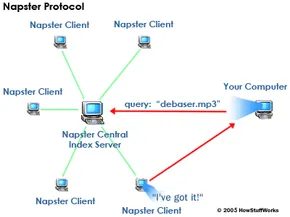
Kazaa rode the same peer-to-peer (P2P) wave that powered Napster, but the architecture was fundamentally different. Napster relied on a centralized server to index and distribute content. If you wanted a song, the server facilitated the connection. It was a single point of failure—and a single point of liability.
Kazaa flipped the script. It uses a decentralized system. Users contact each other directly over the internet to share files. There is no central hub holding the data or coordinating the traffic in the same way.
This structural shift wasn’t just technical—it was defensive. Decentralization meant there was no central entity to sue for copyright infringement in the traditional sense. This independence from a central server is one of the main reasons Kazaa withstood the legal firestorm longer than its predecessors. It blurred the lines of responsibility. You couldn’t just shut down a server to kill the network.
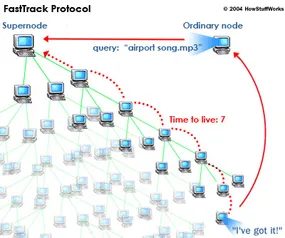

Kazaa didn’t just move files. It built a chaotic, hierarchical traffic system. The backbone was the FastTrack protocol. This wasn’t standard peer-to-peer chaos. It was a “second generation” system designed to handle load. It split users into two distinct classes.
Supernodes sat at the top. These were powerful machines. They had fast connections and high bandwidth. Regular users didn’t even know their computers had been elevated to this status. There were about 30,000 of them. They acted as hubs. Each one handled between 60 and 150 ordinary nodes simultaneously.
Ordinary nodes were the rest of us. When you installed the software, it came with a hardcoded list of supernodes. Every launch required your computer to register with a central server. Then, it picked an active supernode from that list.
The Mechanics of FastTrack and Search Propagation
When you asked for a file, the request didn’t go out into the void. It went to your assigned supernode. That supernode talked to other supernodes. Those supernodes connected to regular nodes. Those regular nodes connected to more regular nodes. It was a ripple effect.
The search had a hard limit. The Time to Live of 7 meant the request could travel seven levels deep into the network. After that, it stopped. It didn’t ping the whole internet. It just went seven hops.
Once the file was found, the transfer happened directly. HTTP (HyperText Transfer Protocol) handled the movement from owner to requester. The supernode wasn’t in the middle of the download. It only managed the search.
Why Unofficial Kazaa Clones Triggered DMCA Action
Kazaa’s success spawned copycats. Programmers and companies wanted in on the action. They built unofficial versions. These clones promised more functionality. They claimed to remove the adware and spyware that plagued the original.
Popular variants included Kazaa Lite Resurrection. Kazaagold was another. Kazaa Lite Tools K++ and Diet K also appeared. Kazaa viewed these as direct threats. In 2003, the company filed complaints under the Digital Millennium Copyright Act (DMCA). The goal was simple. Have the infringing sites removed from the internet.
Is Kazaa Legal? The Liability Debate
Napster had fallen. Kazaa tried a different approach. It claimed total legality. The argument relied on structure. The software itself didn’t host files. It just connected users.
The music and movie industries disagreed. They pointed to the blue files in the interface. Those were controlled by users. They contained copyrighted content. Lawsuits followed. Not just against the company. Against individual users too.
In 2001, a Dutch music company sued Kazaa. They demanded an end to copyright violations. The threat was steep penalties. Kazaa responded by shifting ownership. They moved control to offshore entities. Sharman Networks Limited in Vanuatu became the primary holder.
A Dutch appeals court overturned the initial judgment in 2002. The ruling stated Kazaa wasn’t responsible for user actions. The decentralized structure meant the company wasn’t involved in the actual sharing. Searches and downloads happened between user computers.
Later in 2002, the RIAA and MPAA sued in the US. The case was pending as of February 2005.
Kazaa’s legal shield got stronger in 2003. A US District Court judge ruled that Grokster and Morpheus were not liable for their users’ actions. The precedent helped Kazaa’s argument. Decentralization meant no liability for the platform.
RIAA Lawsuits Against Individual Users
This left only the users exposed. The Recording Industry Association of America (RIAA) started targeting individuals in 2003. They didn’t go after everyone. They targeted repeat offenders. People sharing thousands of files.
These users were identified by IP address. The lawsuits ranged from $750 to $150,000. It was a targeted crackdown. In October 2004, the IFPI joined the fray. They sued several hundred Kazaa users and users of two other services. The strategy was clear. Make sharing expensive.
How Polluted Music Files Sabotaged P2P Networks
The industry lost money. Estimates for 2003 put CD sales losses at $300 million. Lawsuits were one response. Another was sabotage.
Record companies polluted the network. They created fake versions of songs. These fakes were distributed on Kazaa. The first 10 seconds played correctly. The rest was a repeating “blipping” noise.
Users downloaded the fakes. They shared them with others. The number of fake copies grew. It often exceeded the number of real copies. The goal wasn’t to punish. It was to frustrate. Users would abandon the system. They would go buy the real songs instead.
The network became a trap. You couldn’t trust what you downloaded. The quality was degraded by design. The music industry didn’t just sue. They broke the product.
Why Decentralized P2P Systems Still Face Legal Risks
Kazaa’s architecture was clever. It hid behind the users. It claimed no responsibility. But the law struggled to catch up. Courts had to decide if a tool provider was liable for user abuse. The Grokster ruling helped. It set a bar. But the bar kept moving.
The pollution tactic showed the industry’s desperation. They attacked the user experience. They corrupted the data. It wasn’t a technical fix. It was a psychological one.
Today, the specific mechanics of FastTrack are less relevant. The protocols have evolved. The supernode concept is archaic. But the legal questions remain. Who is responsible when a platform enables sharing? The answer still depends on intent. And structure.
The lawsuits against individuals slowed down eventually. The cost of enforcement outweighed the recovery. But the damage to the P2P reputation was done. Trust vanished. You had to verify every file. You had to assume some were traps.
The network persisted. It adapted. The music industry moved on to streaming. But the ghost of polluted MP3s lingers. You can still find them. Hidden in obscure folders. Waiting for the wrong click.
Sharing files isn’t just about swapping MP3s anymore. It’s a security minefield. When you let strangers access your hard drive or pull data from theirs, you’re rolling the dice with privacy.
Kazaa, the king of early P2P, got a terrible reputation for this. The software didn’t just move files. It installed spyware and adware by default. This code tracked your web movements. It downloaded ads silently. Users had to fight through a complicated uninstall process during the initial setup to keep their machines clean.
Today, the company says it doesn’t collect personal data. But the damage was done. Copycats like Kazaagold and Kazaa Lite Tools K++ claimed to be cleaner. They promised freedom from adware. Whether they actually delivered is another story.
Protecting Yourself from Shared Drives
How do you stop a download from eating your entire hard drive? Kazaa users were told to create a specific “My Shared Files” folder. This limited access. Downloaders could only see what was in that folder. They couldn’t wander freely across your personal data.
There was also built-in virus protection. It tried to filter out bugs floating around cyberspace. It wasn’t perfect. Nothing ever is. But it was the only shield users had against the chaos.
The Legal War That Killed Kazaa
Kazaa didn’t die quietly. It was sued into oblivion. The timeline reads like a legal thriller.
- Nov. 29, 2001: The Register reported that Kazaa was ordered to cease infringing copyright.
- Mar. 28, 2002: A Dutch appeals court ruled that KaZaA was legal. A temporary win.
- Jan. 18, 2002: WiredNews reported that Kazaa halted download distribution under pressure.
- May 23, 2002: Newsbytes reported that creators said lawsuits were too costly to continue.
- Sept. 24, 2003: CNN.com reported that the makers of Kazaa were suing record labels, turning the tables.
- Feb. 1, 2005: The Hoya reported that the RIAA stepped up student lawsuits.
The final nail in the coffin came later. There is no single answer for why KaZaA shut down. Some say it was music industry pressure. Others believe Sharman Networks, the parent company, simply decided the hassle wasn’t worth it. Whatever the reason, the service is gone.
Was Kazaa Actually Illegal?
Legality depends on where you live. And on what you share. Downloading copyrighted material without permission is illegal in most places. But the software itself? That’s where it gets gray. The Dutch courts said it was legal. Other courts disagreed.
Why Does This Still Matter?
We think file sharing is over. It’s not. It just moved.
“Pollution in P2P File Sharing Systems” remains a key study. It highlights how malware spreads through trusted networks.
If you’re still using peer-to-peer tools today, the risks are the same. Privacy invasions. Spyware. Legal trouble. The interface looks different. The code is faster. The danger is identical.
Read more about how file sharing works and how home networking protects your data. Check out resources like ShareTheFiles.com and SpywareInfo for clean alternatives. If you want to understand the history, read “Sonic Boom” by John Alderman. Or dig into “Discovering P2P” by Michael Miller.
The sources for this history are vast. From AfterDawn’s coverage of European users being sued to Polytechnic University’s measurement studies. The race to kill Kazaa was won by lawyers, not technologists.
But the technology remains. And the users remain. Are we learning? Or just waiting for the next big download button to appear?