
Remember the leap from VHS to DVD? It felt like magic. Suddenly, grainy tapes became sharp images. You could pause without the tracking lines, skip chapters, and zoom in. Studios piled on commentary tracks and bonus features. It felt like the pinnacle of home video.
Then screens got bigger.
DVDs were designed for small screens. Anything over 36 inches and the picture starts to break down. They aren’t built for modern high-definition (HD) sets. To get true HD without compression artifacts, you needed more storage. Enter the HD-DVD.
The concept was straightforward. It looked like a standard DVD. It acted like a standard DVD. It just held way more data. A standard DVD gives you about two hours of standard definition video. An HD-DVD could hold four to eight hours. If you understood DVDs, you already understood the basics of HD-DVD.
How Disc Storage Actually Works
Both formats rely on the same fundamental physics. Information is stored as microscopic pits arranged in a spiral. A red laser reads these pits from the reverse side of the disc. The player sees them as bumps. The bumps reflect light to a sensor. Electronics convert that reflection into a digital signal.
An HD-DVD player operates similarly but with key upgrades. It needs to process higher data rates. It also outputs a digital signal directly, bypassing the analog conversion many older DVD players required.
HD-DVD Facts
Storage capacity is where the difference becomes tangible. Here is how the formats compare in raw numbers.
Capacity Comparison
- HD-DVD Capacity: 15 GB (single layer), 30 GB (dual layer)
- DVD Capacity: 4.7 GB (single layer), 8.4 GB (dual layer)
Compression Standards
HD-DVDs utilized specific codecs to maximize quality within those larger file sizes.
- MPEG-2
- MPEG-4
- VC-1
Playback Duration
How long could you watch a movie?
- High-definition Playback, 15 GB: 4 hours
- High-definition Playback, 50 GB: 8 hours
HD-DVD Players
The hardware had to catch up to the media.


HD-DVD operates on the same basic physics as its predecessor. You have a reflective layer with microscopic bumps. A laser hits those bumps. A sensor catches the reflection. The result is a digital signal.
The physical dimensions haven’t changed. It’s still 120 millimeters wide and 1.2 millimeters thick. So, what makes them hold so much more data?
Three specific differences do the heavy lifting. First, the laser color. Second, the density of the tracks. Third, the compression algorithms used to store the video.
The Blue-Violet Advantage
Standard DVDs use red lasers with a wavelength of 650 nanometers. HD-DVDs switched to blue-violet lasers at 405 nanometers.
Shorter wavelength. That’s the key.
Because the beam is tighter, it can read smaller pits. It can also navigate tracks placed closer together. This is measured as track pitch. A regular DVD has a track pitch of 0.74 micrometers. An HD-DVD squeezes this down to 0.40 micrometers.
Think of it like writing. A red laser is a magic marker. The blue-violet laser is a fine-tip pen. You can fit significantly more text on the page with the finer point. This narrower track pitch is what allows the disc to pack in more information without increasing the physical size.
Compression Matters
The second major shift involves how data is compressed. Most DVDs rely on MPEG-2. It’s reliable, but old.
HD-DVDs can use MPEG-2, but they typically default to MPEG-4. Or VC-1, also known as Windows Media. These formats are far more efficient. They deliver higher video quality while keeping file sizes smaller.
This efficiency matters when you’re trying to fit hours of high-definition content onto a single-layer disc.
Speed and Signal Integrity
There is a third difference, though it’s less about storage and more about delivery. General improvements in manufacturing mean HD-DVD players read data roughly three times faster than DVD players.
But speed isn’t the main selling point. It’s the output.
These players send the signal to an HDTV digitally. They use the High Definition Multimedia Interface (HDMI). This bypasses analog conversion entirely. Analog conversion degrades quality. Digital transmission preserves it. You get a cleaner picture on the screen.
Will Your Old Discs Become E-Waste?
One of the first questions people ask about HD-DVD (besides “Is it better than Blu-ray?”) is whether their old DVDs are about to become obsolete.
Let’s take a look at what is likely to happen with players and discs as people upgrade.
Standard vs. High-definition
Wondering what the difference is between standard and high definition? Standard definition (SD) uses 525 lines of pixels from top to bottom. High definition (HD) uses up to 1125 lines.
Not all of these lines are visible on the screen, but they’re included as part of the signal.
DVD Compatibility

If you snapped up an HD-DVD player on launch day, you didn’t lose your library. The hardware could still spin your standard DVDs. The reverse wasn’t true. Your old DVD player couldn’t touch a high-definition disc. That asymmetry makes sense. It’s about how the tech works.
The physical discs look identical. Same size. Same shape. Manufacturers took advantage of this similarity. They built players with dual-purpose laser pickups. The Toshiba model released in April 2006 is a prime example. It reads DVDs. It reads HD-DVDs. It even handles CDs. You get backward compatibility without needing a completely separate machine.
The Reality of Home Theater Upgrades
Even if HD-DVD had won the format war, standard DVDs would have survived. The market data was clear. Most US households didn’t own HDTVs yet. Why buy high-definition media if your screen can’t show it? The upgrade path was tied to hardware adoption, not just disc availability.
When companies needed to bridge the gap, they got creative with disc layers.
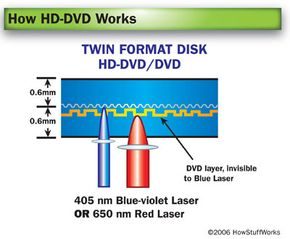
Twin format discs offer a clever solution. They stack two layers on one side. The top layer is standard DVD. It uses a red laser. The bottom layer is HD-DVD. It uses a blue laser. The design is optical. The top layer is transparent to blue light. So the blue laser passes right through the standard video layer to hit the high-definition data underneath. You don’t need two sides. You just need the right laser switching.
Two-Sided Discs and Combination Formats
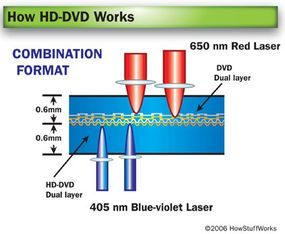
Not every solution requires stacking. There’s also the combination format. This approach splits the content physically. It uses a two-sided disc.
One side is standard DVD. A red laser reads it. The other side is HD-DVD. A blue laser reads it. You flip the disc to switch formats. It’s a simpler manufacturing process than the twin-layer method. But it’s less convenient for the user.
Which method is better? Twin format keeps everything in one place. Combination format separates the experience entirely. Both prove that the industry knew standard definition wouldn’t vanish overnight. They built in redundancy. They expected you to keep your old discs while testing the new tech.
It wasn’t just about storage capacity. It was about survival. Keeping the old format alive on the same physical medium extended the life of the investment. For a brief moment, you could hold both standards in one hand. The laser just did the work of choosing which one mattered.

The Hybrid Disc Strategy
If you bought a combo disc back in the day, you got two formats on one piece of plastic. It played in standard DVD players and HD-DVD players alike. This was a smart move for anyone planning to upgrade to high-definition later. Rental stores and private libraries loved them. They let customers watch with old hardware while waiting for the new gear.
Then HD-DVD died. The format collapsed. Now, consumers were left hoping for Blu-ray/DVD hybrid players to fill the gap.
The Real Rival: Blu-ray
HD-DVD wasn’t the only game in town. It fought a brutal war against Blu-ray. The industry split into two camps. Toshiba backed one. Sony backed the other. Each side bet the other format would fail. But they weren’t just marketing fluff. There were technical differences.
Up-conversion Tech Explained
Standard DVDs struggle on big screens. They are built for 480-line analog displays. That resolution is too low for modern 1080p TVs.
The Toshiba HD-DVD player handled this with up-conversion. It took standard DVDs and scaled them up for 720p or 1080p screens.
The picture wasn’t native HD. It didn’t have the full resolution of a true HD-DVD disc. But it looked better than the analog signal from an old DVD player. You got a sharper image without buying a new movie.


For a brief, chaotic window in the mid-2000s, the future of home video hung in the balance. It wasn’t just about picture quality anymore. It was a proxy war between tech giants, mirroring the VHS-Betamax battles of the 80s, but with higher stakes and deeper pockets. Two formats emerged as the clear frontrunners: HD-DVD and Blu-ray.
The similarities were superficial. Both ditched the old red lasers for blue ones. Both relied on similar video and audio compression standards. The real difference lay in capacity and corporate backing. Blu-ray discs offered 50 GB on a dual-layer disc. HD-DVD maxed out at 30 GB. That extra storage wasn’t just marketing fluff; it mattered for uncompressed audio and high-bitrate video.
The Early Price and Timing Gap
HD-DVD had the first-mover advantage. Toshiba, the primary force behind the format, secured approval from the DVD Forum. The DVD Forum is the same body that governs standard DVDs, and Toshiba held a seat on its steering committee. This gave HD-DVD a veneer of legitimacy that Blu-ray initially lacked.
Timing was everything. HD-DVD players launched on April 18, 2006. Blu-ray didn’t hit the U.S. market until June 2006. That two-month head start allowed HD-DVD to capture early adopters before Sony’s PlayStation 3 drove Blu-ray into living rooms in November.
Price also played a role. HD-DVD players started around $399, dropping to roughly $290. They were cheaper because manufacturers could use existing equipment to press the discs. Blu-ray required new tooling. Critics argued that Blu-ray’s higher capacity was overkill. No movie needed 50 GB. Why pay more for space you’d never use?
Corporate Alliances and Hollywood’s Bet
The alliances were stark. Toshiba, Microsoft, and Intel backed HD-DVD. Microsoft even released an add-on HD-DVD drive for the Xbox 360 in November 2006. It was a strategic move to keep the console relevant in the HD race.
Blu-ray had the entertainment industry. Sony launched the PS3 with a built-in Blu-ray drive. Dell and Apple joined the Blu-ray Disc Association. But the real heavyweight was Hollywood. Disney, Fox, and most major studios backed Blu-ray. Their reasoning was practical. New manufacturing equipment meant higher barriers to entry. Piracy, which had plagued standard DVDs, would be harder on a new, proprietary format.
The format war dragged on for two years. In the beginning, no one knew who would win. Many tech reviewers leaned toward HD-DVD. It was cheaper. It had Microsoft behind it. It had the DVD Forum’s seal of approval.
The Encoding Myth
If you dig into old forums and specs sheets, you’ll find a persistent confusion about capacity. Toshiba claimed a 30 GB HD-DVD could hold eight hours of HD video. The Blu-ray Disc Association said a 50 GB disc could hold eight and a half hours.
How does a smaller disc hold nearly the same runtime? The answer isn’t magic. It’s bit rate and encoding efficiency.
Early Blu-ray tests often used MPEG-2 encoding. That format is older and less efficient than MPEG-4. A file recorded at a lower bit rate takes up less space. So, a 30 GB disc using efficient encoding and a lower bit rate could stretch its runtime to match a 50 GB disc using inefficient encoding and a higher bit rate.
The numbers weren’t rigged. They were just apples and oranges.
Why Blu-ray Won
The death of HD-DVD wasn’t sudden. It was a slow bleed. Microsoft pulled the plug on the HD-DVD drive for Xbox in 2007. That was the death knell. Without Microsoft’s software ecosystem and hardware support, the format had nowhere to go.
But why did studios switch? It wasn’t just about capacity. It was about control. Blu-ray’s encryption and manufacturing requirements gave Hollywood leverage. They could track discs. They could make piracy harder. HD-DVD, built on older DVD infrastructure, felt like a step backward in security.
Today, Blu-ray is the standard. But the victory came at a cost. The war delayed the adoption of HD home video. Consumers waited years for prices to drop. Studios spent millions on legal battles and marketing instead of content innovation.
The format war taught us something important. Technology doesn’t always win on its own merits. It wins when the right people believe in it. And sometimes, it wins because everyone else gets tired of fighting.
The industry moved on to streaming. Physical media became a niche for collectors. But for a few years, Blu-ray vs. HD-DVD defined what high definition meant. And in the end, the one with the bigger


The Bleeding Edge of the Format War
The format war between Blu-ray and HD-DVD wasn’t just about tech specs. It was about shelf space, studio contracts, and survival. Studios hedged their bets, churning out discs for both formats until the inefficiency became unsustainable. Retailers faced the same problem. Should they dedicate valuable floor space to two competing formats? If one failed, the other would be left stranded in a dead-end aisle. The industry consensus was clear: we needed one winner.
By summer 2007, the momentum had shifted. Dedicated Blu-ray player sales were lukewarm, but Sony’s inclusion of a Blu-ray drive in the PlayStation 3 changed the game. It wasn’t just a console; it was a Trojan horse for the format. Home Media Research reported that Blu-ray discs outsold HD-DVDs by a two-to-one ratio in the first half of 2007. That’s a significant gap. But HD-DVD backers weren’t ready to fold. Paramount and Dreamworks doubled down on exclusive HD-DVD content. Steven Spielberg’s films at Paramount still appeared on Blu-ray, but the intent was clear.
Then came the retail slaughter. Blockbuster Video dropped HD-DVD entirely, switching its high-definition selection exclusively to Blu-ray. Target followed suit, removing HD-DVD players from shelves to make room for Blu-ray machines. Tech bloggers and professional reporters alike declared HD-DVD dead on arrival. Yet, the die-hards kept fighting.
Predictions stretched into 2009. Companies that had hoped for a universal hybrid player abandoned those dreams. Toshiba’s HD-DVD players remained cheaper than dedicated Blu-ray machines, a price advantage that kept hope alive for supporters. Lower cost usually wins in consumer electronics. Why pay more for marginal gains?
But the tide turned with brutal speed. Studios began defecting in droves. By January 2008, Warner Bros. announced it was going all-in on Blu-ray. The writing was on the wall. HD-DVD was left with only two major studios: Universal and Paramount. And even then, the alliances were crumbling. Universal’s exclusivity agreement had just expired. Paramount’s contract contained a loophole—if Warner Bros. jumped ship, Paramount could follow. Warner Bros. had already left.
The industry knew it was over when Toshiba pulled out of the 2008 Consumer Electronics Show. No press conferences. No big announcements. The HD-DVD booth remained, but it was a shadow of its former self. It was a plain square. Blu-ray’s booth was a giant, ghostly pirate ship. The visual contrast said everything. One format was sailing away. The other was sinking.
Retail giant Wal-Mart soon followed Blockbuster and Target, stocking only Blu-ray movies and electronics. In February 2008, Toshiba officially conceded. The company announced it would stop manufacturing HD-DVD players by March. The war was over. Blu-ray won.
Is HD-DVD Actually Dead?
The story of HD-DVD feels complete. The format is extinct. Right?
Not quite.
In China, manufacturers are throwing support behind CH-DVD, an offshoot of the HD-DVD format. It’s a localized variant. A ghost in the machine. Will this regional support resuscitate the format? Could it reignite the war with Blu-ray? Probably not. But in tech, nothing is ever truly dead. It just goes dormant. And China is watching.
The Final Verdict on the Format War
It didn’t take long for the high-definition format war to boil down to a single question. Which optical disc standard would survive the corporate turf war? The answer is clear now. Blu-ray emerged as the dominant format, leaving HD DVD as a relic of a failed experiment.
Toshiba’s decision to exit the market was the death knell. By February 2008, the company officially stopped producing HD DVD players. The logic was simple. Retailers had already abandoned the format. When major chains like Target and Walmart stopped stocking HD DVD players, the ecosystem collapsed. Consumers saw the writing on the wall. They stopped buying the hardware.
Why Retailers Chose One Over the Other
Retailers don’t gamble. They follow the supply chain. If studios won’t support a format, retailers won’t stock the players. That was the dynamic in play.
- Target went all-in on Blu-ray early on, dropping set-top players for HD DVD entirely.
- Walmart followed suit, backing the Blu-ray Disc Association’s standards.
- Blockbuster, the giant video rental chain, bet on Blu-ray, signaling to customers that this was the future of physical media.
Even though some studios like Disney briefly supported HD DVD, the majority of major Hollywood studios backed Blu-ray. Without content, a player is just a black box. The library of movies available on Blu-ray grew faster. The market shared data confirmed it. Blu-ray outpaced HD DVD in U.S. sales by late 2007.
The Technical Edge
Why did Blu-ray win? It wasn’t just marketing. It came down to specs. The Blu-ray Disc Association set a standard that offered higher storage capacity. This mattered for high-definition video.
HD DVD used a smaller disc structure. It could hold up to 30GB on a dual-layer disc. Blu-ray went further. It offered 50GB on a dual-layer disc. That extra space allowed for higher bitrate video and more bonus content. The technology used blue-violet lasers. These lasers have a shorter wavelength than the red lasers used in DVDs. This allowed for smaller pits and tighter tracks.
“Blu-ray could win high-def battle.” — Variety, Jan. 10, 2008
The technical superiority wasn’t just a number on a page. It meant better picture quality. It meant fewer compression artifacts. For home theater enthusiasts, that difference was noticeable.
The Aftermath and Legacy
Toshiba tried to keep the flame alive. There were whispers of a resurgence in China. But the momentum was gone. The infrastructure for HD DVD manufacturing had been dismantled. The patents were sold off or abandoned. The format war ended not with a bang, but with a quiet cessation of production.
For consumers, it was a confusing few years. You had to choose. Would you buy into a format that might disappear? The risk was real. But the choice became easier as time went on. One option had the studios. The other had the retailers.
Where Do We Stand Today?
The fight is over. Blu-ray became the standard for physical high-definition media. It lasted longer than many expected, competing with the rise of streaming services. But the core technology remains relevant.
- Disc Capacity: Blu-ray discs can hold significantly more data than DVDs or the extinct HD DVD.
- Resolution Support: It supports 4K Ultra HD Blu-ray, extending its life well beyond the initial 1080p era.
- Hardware Availability: Players are still produced, though they are niche products in a streaming-dominated world.
The lessons from the format war still apply. Technology standards require ecosystem support. You need players. You need studios. You need retailers. When one piece fails, the whole system falters.
We don’t talk about HD DVD much anymore. It’s a footnote in tech history. But it serves as a reminder. In the digital age, even the most robust technology can lose if it doesn’t capture the market. The winner wasn’t just the one with the better laser. It was the one with the bigger backing.