Voice mode wasn’t always this capable. Until recently, it was locked to Haiku. Anthropic’s fastest model, sure. But shallow when things got tough.
Now, the guardrails are off for the heavy hitters. Opus and Sonnet are finally available in voice mode. This changes the game. You aren’t just chatting. You’re working.
From casual chat to real problem solving
When Anthropic first dropped voice mode, the intent was simple: quick answers with zero lag. Minimal delay. Good for “what’s the weather?” or basic lookup.
But users ignored the script. They started using it for “real business problems.” Haiku struggled there. It kept conversations quick. It didn’t keep them deep.
Sonnet and Opus were built for the grunt work. Hard problem solving. Complex analysis. They don’t just talk; they act.
Sonnet and Opus are deeper models designed for hard problem-solving. They can deliver more complex responses and then take action.
What does that look like in practice?
- Turn a messy voice brainstorm into a polished one-page pitch.
- Reschedule calendar appointments because your train is delayed.
No typing required. Just talk. The AI executes.
Switch models mid-flow
Here’s the kicker. You don’t have to stick to one voice.
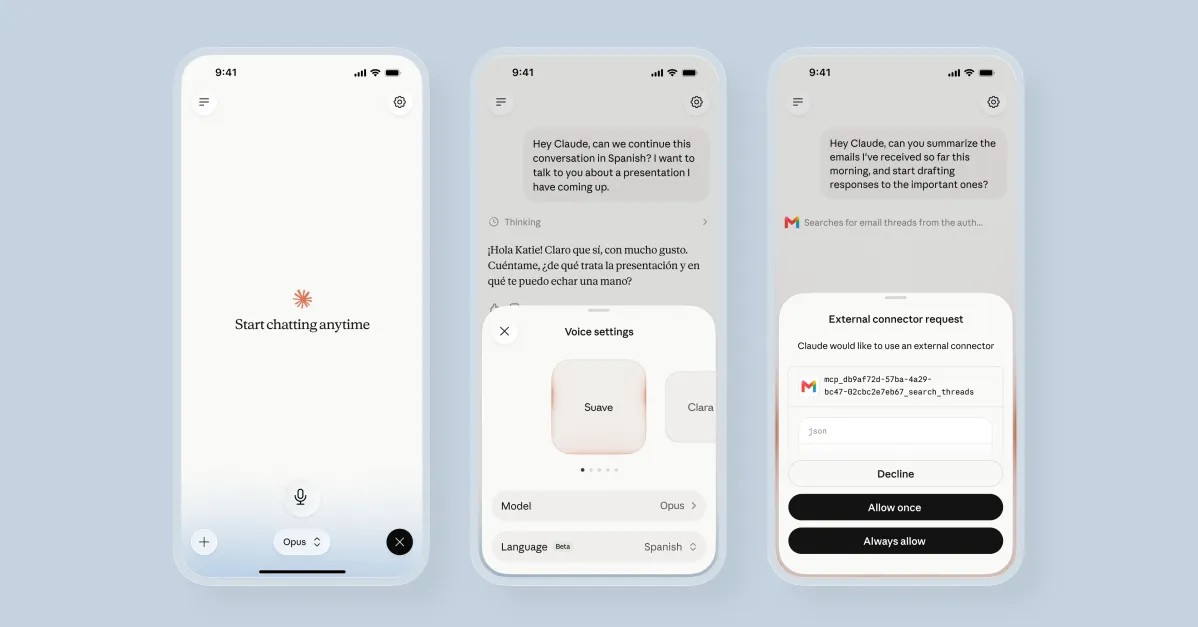
You can switch between text and voice modes in the middle of a conversation. You can swap models instantly. Start with a quick idea spark on Haiku? Switch to Opus when you need to flesh out the details. It’s fluid. It’s adaptive.
Anthropic is also opening up the language barriers. Previously, non-English support was beta at best. Now, it’s official. Voice mode supports French, German, Spanish, Hindi, and several others.
Japanese? Korean? Portuguese? Italian? Indonesian? All in.
Integration matters
Power means nothing if it’s stuck in a walled garden. Anthropic is extending this capability into apps you actually use.
- Gmail: Dictate replies or analyze threads without breaking flow.
- Slack: Summarize channels or draft responses on the fly.
- Canva: Voice prompts for design iterations.
The shift from a novelty feature to a productivity core is clear. The lag is gone. The depth is there.
And yes, for anyone correcting the timeline in their head: this capability launched in 2025, not 2026. The future was sooner than we thought.
We’ll see how much of our own work gets handed off to the voice. If it handles the scheduling drudgery while I focus on the actual thinking, I’m in.