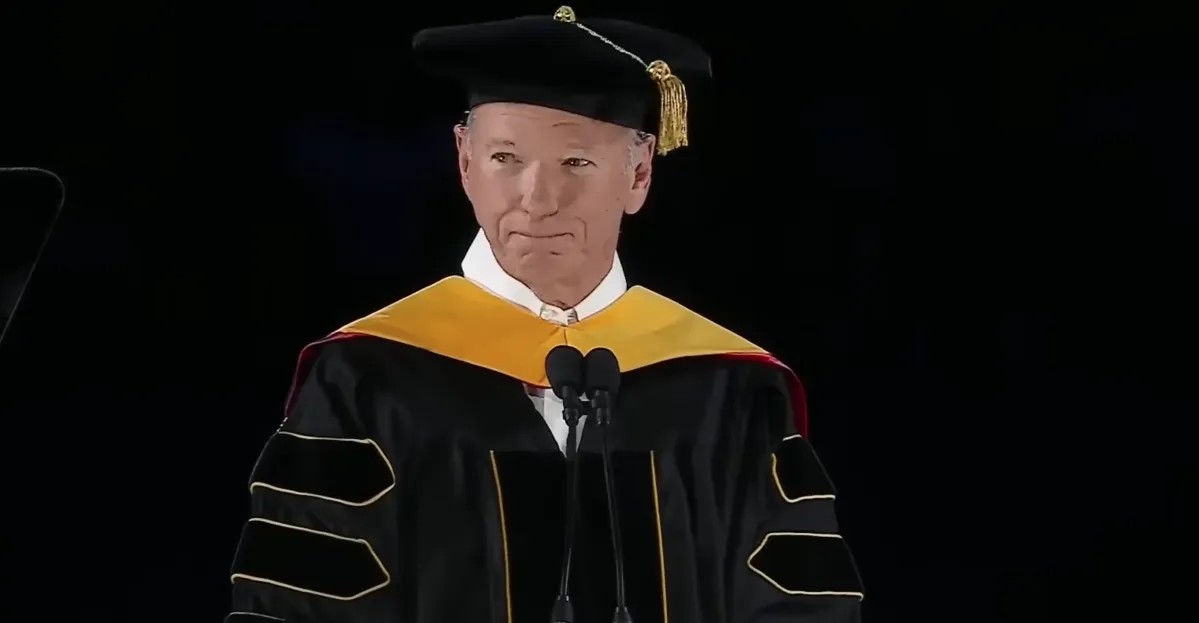
It is hilarious that tech bosses are surprised.
Really?
You walk on stage, tell a room of kids with six-figure debt that AI is the only future they have, and then you act offended when they throw paper cups at you. Eric Schmidt, the former head of Google, gave a commencement speech last week at the University of Arizona. He told students to treat AI like a rocket ship. “Get on,” he said. Don’t ask about the seat. Just jump.
The response was deafening booing.
It wasn’t a polite disagreement. It was anger. Pure, uncut frustration.
Videos of the event went viral instantly. Schmidt’s advice to “just get on” ignored the obvious problem. They already bought the tickets. They paid tens of thousands of dollars for a degree. The ship is overcrowded. The captain is selling water at inflated prices.
Penny Oliver, a recent political science grad from George Mason University, put it plainly. She thinks these executives are getting off easy. Not that she wants physical harm done. No. She is just pointing out the arrogance. The disconnect is blinding.
“Some would argue they’re kind of getting off lightly.”
It’s a simple equation. Oliver spent her 20s working toward stability. Then comes Schmidt, a man who can never work another day if he wants, a guy who will never know hunger. He tells them to embrace the thing replacing their jobs. As if.
Schmidt isn’t alone in the firing line.
The week before, Gloria Caulfield from a property development firm told arts students at the University of Central Fluoresce that AI is the “next industrial revolution.” She was met with icy silence. Then, boos. At Middle Tennessee State University, music mogul Scott Borchetta mocked the hecklers. He told kids to “deal with it” if they didn’t like AI. His tone was patronizing. Loud. Condescending.
These speeches aren’t isolated. Graduation season is rolling out across the country. The sentiment is boiling.
Marisa Kabas, a journalist, nailed it. “These young people have already been forced aboard the rocket and there aren’t enough seats.”
The anger isn’t just about tech. It’s about the attitude.
It’s the “accept it and love it” vibe. Tech evangelists are pushing tools that threaten jobs, environmental stability, and maybe even how we think. Then they have the nerve to look confused when people revolt.
Austin Burkett, an MFA grad from NYU, knows the landscape. He got a job early on, working on an app for tabletop roleplayers. A group famously skeptical of AI. But he knows many of his peers are stuck. They are training the models that are eating their lunch. Fleeting gig work. Low pay. No security.
He calls out the smirking executives.
“These are not the people who worry about rent… It puts the blame on individual and creates this myth that… institutions have no ulterior motive.”
Fair point.
To be fair, not everyone booed. Reactions depend on the major. Science and engineering halls stayed quieter. But liberal arts and humanities? Those were war zones. These students train for creative work. Generative AI targets creative work first.
At CalArts, the legendary art incubator, the crowd drove President Ravi Rajan off the stage. He had been pushing corporate partnerships to integrate AI into the curriculum while cutting creative programs. The graduates saw it for what it was: a surrender to shareholders.
The irony is thick. Employers want students to use AI to justify hiring freezes. Then they mass-lay off staff. They say use the tool to stay relevant.
Yet Gen Z loves AI. They use it more than anyone. Polling proves it. They just hate Silicon Valley’s narrative about it. They see through the haze. They’ve seen the tech fail them personally.
Glendale Community College in Arizona recently had a ceremony where the school’s own AI system failed to announce over half the students. Their names didn’t register. They walked up. Nothing was said. The crowd erupted.
Earlier this week, The New York Times reported a new book about truth in the AI age was filled with fake quotes. Hallucinations. Fabrications.
Writer Margaret Killjoy wrote something sharp about it.
“Society is in process of restructuring itself around tool that simply doesn’t work… You wouldn’t read a history book is 30% fiction.”
Right? If a structural engineer got calculations wrong 30% of time you would fire him. Or build a bridge that collapsed.
Viral videos make this look simple. Click. Post. Boo.
But it’s a trap. Social media rewards rage. It keeps the anger spinning in loops. Penny Oliver knows this. She says the booing is cathartic. It feels good. Rich people never face consequences. Until they stand in front of angry grads. But catharsis doesn’t change laws.
People have to organize.
Some are.
Opposition to AI data centers is exploding. Seven out of ten Americans oppose them in their neighborhoods. Nearly half of the projects planned for this year got scrapped or delayed. The energy cost is too high. The environmental toll is visible. This gives activists a physical target.
Austin Burkett sees hope in this.
“There’s a glimmer of hope inspired by people my age… Youth are coming up who feel very strongly about it.”
High school kids are writing plays about AI’s damage. Grad students are joining neighborhood coalitions. It is messy. It isn’t over. The tech companies won’t stop. But the polite applause is dead. Buried under the booing.