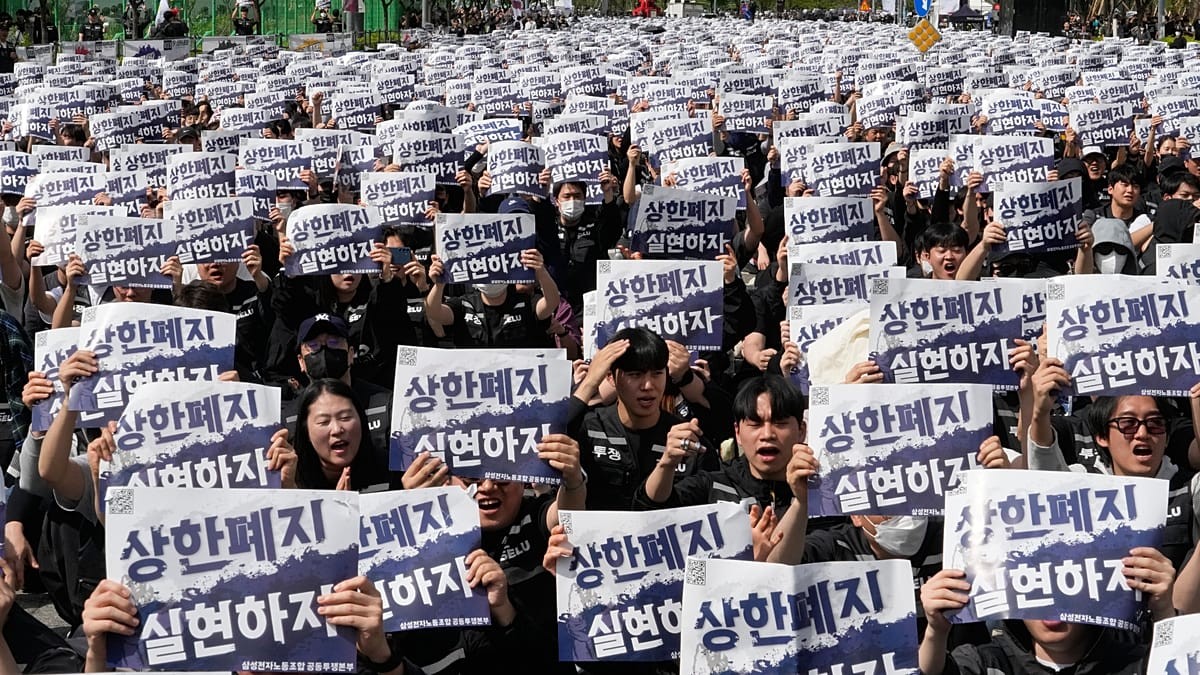
Thousands of employees at Samsung Electronics gathered at the company’s semiconductor complex in Pyeongtaek, South Korea, on Thursday to protest against current bonus structures. The demonstration comes at a pivotal moment for the tech giant, as the global surge in Artificial Intelligence (AI) drives unprecedented demand for memory chips, leading to record-breaking profits.
The Core of the Dispute: Transparency and Caps
The protest, which union representatives estimate involved approximately 40,000 members, centered on a demand for more equitable profit-sharing. Workers are calling for two primary changes:
– Increased transparency regarding how bonuses are calculated.
– The removal of maximum limits (caps) on bonus payouts.
The union, which represents roughly 74,000 workers, has already rejected management’s proposal to offer bonuses in the form of restricted stock. Instead, employees are pushing for direct compensation that reflects the company’s massive financial gains.
High Stakes: The Cost of a Potential Strike
The tension is escalating toward a potential industrial standoff. If negotiations with Samsung management fail, the union has threatened an 18-day strike scheduled to begin on May 21.
The financial implications of such a move would be staggering. Estimates suggest a strike could cost Samsung upwards of 1 trillion won (€578 million) per day, potentially disrupting the global semiconductor supply chain during a period of peak demand.
A Tale of Two Competitors
The timing of the protest highlights a growing competitive tension in the semiconductor industry. On the same day as the Samsung protests, its primary rival, SK Hynix, reported its best-ever quarterly results.
The contrast is stark:
1. SK Hynix is seeing record revenue and operating profits fueled by the massive expansion of data centers and AI infrastructure.
2. Samsung has forecasted a record first-quarter operating profit of approximately 57.2 trillion won (€33 billion).
Together, Samsung and SK Hynix control roughly two-thirds of the global memory chip market. This concentration means that labor unrest at Samsung could have significant ripple effects across the entire global tech economy, affecting everything from smartphone production to AI server availability.
Global Headwinds: Geopolitics and Supply Chains
While the AI boom provides a massive tailwind for semiconductor manufacturers, the industry faces growing external risks. Geopolitical instability, particularly the conflict in the Middle East, poses several threats:
– Material Shortages: Disruptions in the supply of critical gases, such as helium, which are essential for chip fabrication.
– Energy Costs: Fluctuations in energy prices that impact high-intensity manufacturing processes.
Despite these concerns, industry leaders remain cautiously optimistic. SK Hynix’s CFO, Woo Hyun Kim, noted during a recent conference call that while the company is monitoring the conflict closely, they do not currently expect a significant impact on production.
The central tension for Samsung lies in balancing its massive windfall from the AI revolution with the growing demands of a workforce that feels left behind by the company’s record-breaking performance.
Conclusion
Samsung is caught in a high-stakes standoff between management and a workforce demanding a larger share of the AI-driven windfall. The outcome of these negotiations will not only determine Samsung’s internal stability but could also impact the global semiconductor supply chain and the pace of the AI revolution.