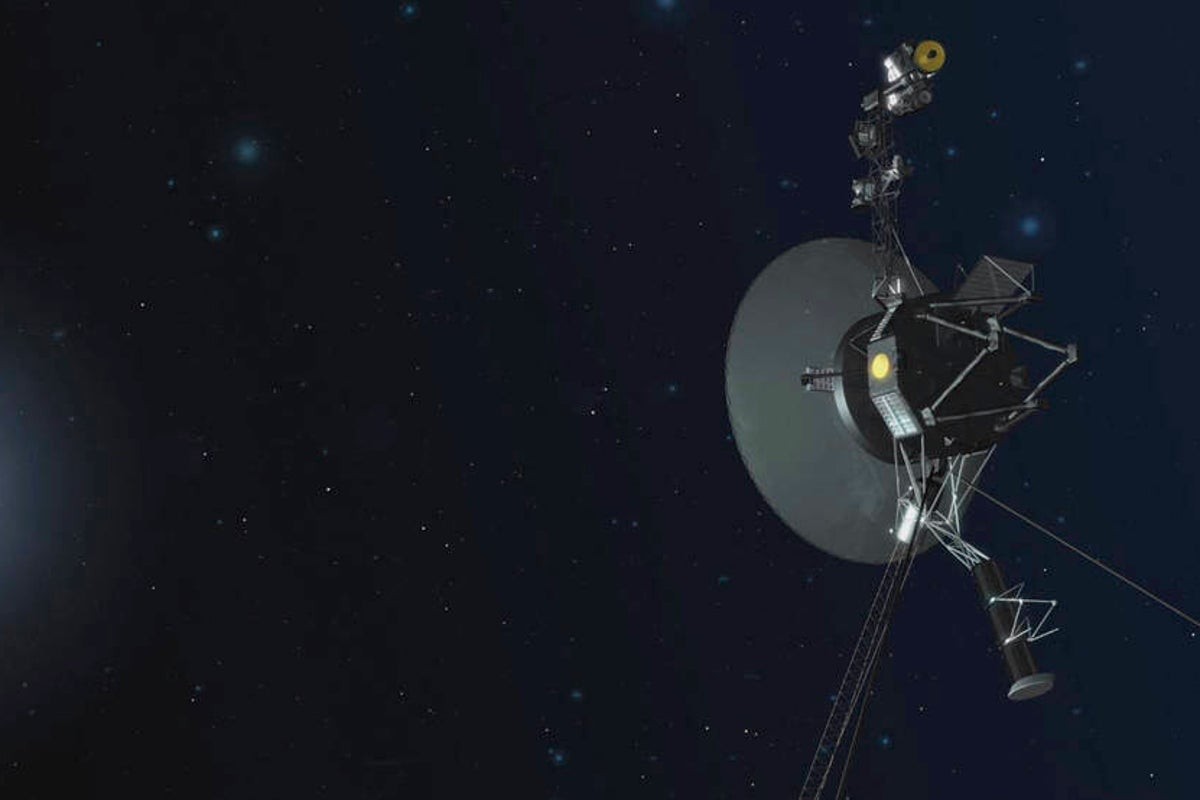
NASA engineers are working urgently to address a critical power shortage on Voyager 1, the most distant human-made object in existence. To prevent a total system failure, mission operators have been forced to deactivate one of the probe’s scientific instruments, a move intended to preserve the spacecraft’s ability to transmit data from interstellar space.
The Challenge of Interstellar Longevity
Launched in 1977, Voyager 1 has spent nearly five decades exploring the cosmos. In 2012, it made history by becoming the first spacecraft to leave our solar system and enter interstellar space. However, its longevity is fundamentally limited by its power source.
The probe relies on a radioisotope thermoelectric generator (RTG), which converts the heat from decaying plutonium into electricity. Because radioactive decay is a finite process, the probe loses approximately 4 watts of power every year. This gradual decline is an expected part of deep-space missions, but recent fluctuations have forced NASA into an emergency management mode.
Emergency Measures and Instrument Shutdown
The current crisis was triggered on February 27 during a planned maneuver. Engineers detected an unexpected drop in power levels, raising fears that the probe’s internal protection systems might automatically shut down vital components to prevent permanent damage.
To mitigate this risk, NASA has taken the following steps:
– Deactivated the Low-energy Charged Particles (LECP) experiment: This instrument has been operational for 49 years, measuring cosmic rays and particle density in the Milky Way.
– Prioritized remaining systems: By shutting down the LECP, engineers aim to stabilize the power supply for the two remaining active instruments.
– Focusing on core science: The probe continues to successfully transmit data regarding plasma waves and magnetic fields, providing unique insights into the interstellar medium.
“While shutting down a science instrument is not anybody’s preference, it is the best option available,” stated Kareem Badaruddin, Voyager mission manager.
Why Voyager 1 Matters
The loss of the LECP instrument is a significant blow to science, but it is a calculated sacrifice. Voyager 1 and its twin, Voyager 2, are currently the only human-made objects positioned far enough from Earth to study the regions beyond our heliosphere.
The data provided by these probes—specifically regarding pressure fronts and particle density in interstellar space—is irreplaceable. Without Voyager 1, humanity would lose its “eyes and ears” in the vast, uncharted territory between stars.
Looking Ahead
NASA is currently developing a “far-out plan” to manage the remaining energy more efficiently and extend the mission’s lifespan. The goal is to keep the spacecraft operational for as long as possible, ensuring that even with diminished capabilities, it can continue its historic journey through the interstellar medium.
Conclusion: NASA is balancing the loss of scientific capability against the survival of the mission, sacrificing one instrument to ensure Voyager 1 can continue its unprecedented exploration of interstellar space.