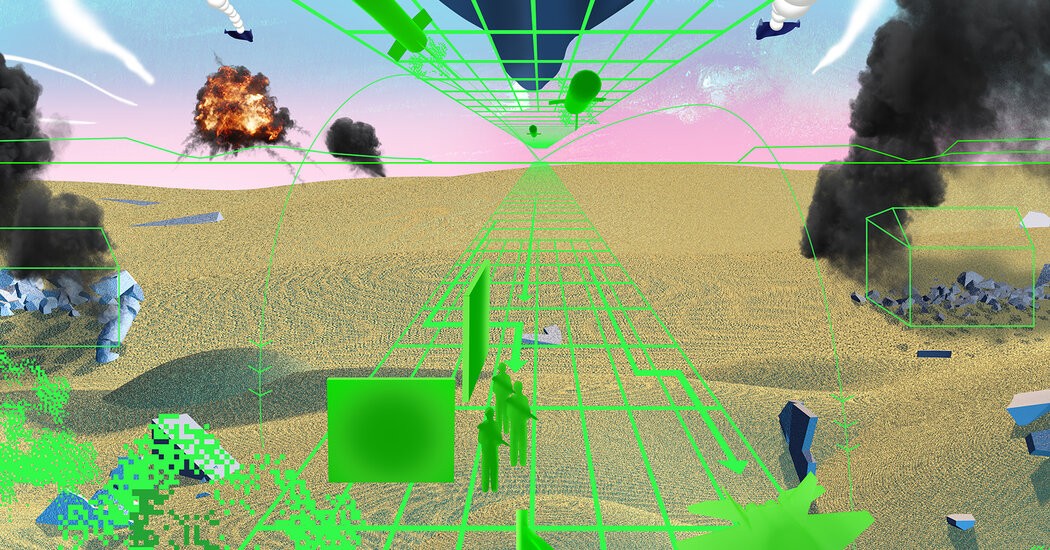
For decades, U.S. military planners faced a daunting geopolitical reality: any attempt to neutralize Iran’s nuclear capabilities or change its regime would necessitate a massive ground invasion. Iran’s vast, mountainous geography and its deeply fortified military infrastructure—much of which is tucked away in subterranean bunkers and caves—meant that traditional warfare would inevitably result in significant American casualties.
This physical obstacle birthed a modern technological ambition: the dream of remote-controlled warfare. The goal was to use Artificial Intelligence (AI) and autonomous systems to fight major adversaries indefinitely, removing American citizens from the line of fire.
The AI Revolution in Targeting
The integration of machine learning and advanced surveillance has fundamentally altered the “nuts and bolts” of combat. We have moved from a world of delayed intelligence to one of near-instantaneous reaction.
- Speed of Decision-Making: As noted by Adm. Brad Cooper, commander of U.S. Central Command, AI tools have compressed targeting processes that once took hours or even days into mere seconds.
- Real-Time Precision: In the pre-9/11 era, intelligence was often static. For example, the strike intended for Osama bin Laden relied on satellite-phone data that was outdated by the time missiles arrived. Today, drones and missiles can receive live data feeds, allowing them to adjust their course and speed mid-flight based on real-time visual inputs.
- Data Fusion: Modern warfare relies on “blanket surveillance.” U.S. drones currently collect a massive stream of video, imagery, and intercepted signals, which are transmitted to warships in the Persian Gulf. This data is then cross-referenced with digital footprints—such as phone numbers, communication transcripts, and recent travel patterns—to create a high-fidelity picture of the battlefield.
The Reality Gap: Why Technology Faces a Ceiling
Despite these staggering advancements, the conflict in Iran is exposing a critical truth: digital superiority does not equal total control. The “remote-controlled” dream is hitting the hard wall of physical reality.
While AI can process data at lightning speed, it struggles to overcome the sheer scale and dispersion of modern asymmetric threats. Iran’s military strategy utilizes two specific advantages that complicate high-tech warfare:
-
Massive Drone Swarms: The sheer volume and distribution of Iranian drones can overwhelm even the most sophisticated automated defense systems.
-
Mobile Hardware: Short-range missiles, particularly those launched from mobile platforms,, can remain hidden and even under constant satellite surveillance. If a target is constantly moving and and decentralized, the “eyes in the sky” cannot always guarantee a strike.
The Strategic Implication
This tension highlights a growing trend in modern geopolitics: the gap between intelligence capabilities and kinetic success. While the U.S. can now “see” more clearly and “decide” faster than ever before, the ability to actually neutralize a deeply entrenched, mobile, and dispersed enemy remains a physical challenge that algorithms cannot yet solve.
The transition from traditional ground warfare to AI-driven remote warfare has reduced the risk to soldiers, but it has not eliminated the fundamental difficulty of defeating a determined adversary in complex terrain.
The conflict in Iran serves as a sobering reminder that while AI can accelerate the speed of war, it cannot bypass the physical complexities of the battlefield.
Conclusion
The advent of AI has revolutionized targeting and intelligence, offering the promise of bloodless remote warfare. However, Iran’s use of mobile, dispersed, and mass-produced weaponry demonstrates that technology alone cannot substitute for the physical presence required to secure a definitive victory.