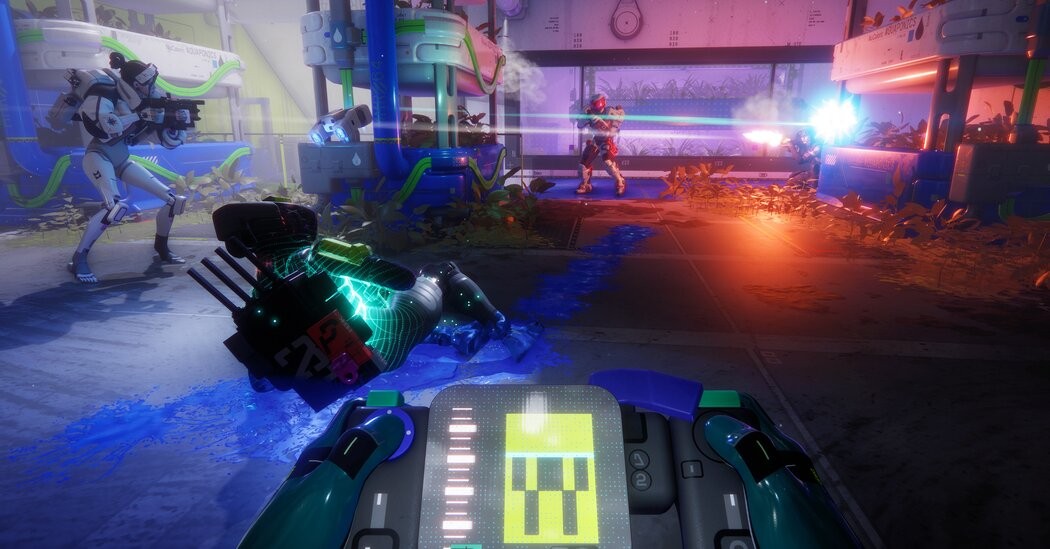
The latest installment of Marathon, a first-person shooter developed by the team behind Halo and Destiny, plunges players into a stark, futuristic world where humanity is the anomaly. Players inhabit synthetic bodies, digital consciousnesses cast across space to scavenge a failed colonial project abandoned a century ago. This premise, once firmly rooted in science fiction, now resonates with unsettling immediacy.
The Past and Present of Marathon
The original Marathon, released in the mid-1990s for Macintosh, arrived at a time when artificial intelligence existed primarily as a theoretical concept. The internet was in its infancy, and AI seemed like a distant fantasy—the realm of HAL 9000 or Asimov’s robots. The gaming experience then was isolating, often played in darkened rooms with the slow crawl of dial-up modems.
Today’s Marathon emerges into a radically different landscape. Video games are mainstream entertainment, blurring into popular culture. AI is no longer a future threat, but an encroaching reality, integrated into everyday tools from word processors to smart appliances. Large language models are accessible with a single prompt, and the line between human and machine is increasingly blurred.
A Dark Aesthetic Reflects a Changing World
Visually, the original Marathon stood apart from contemporaries like Doom. While Doom embraced bright, explosive action, Marathon adopted a cold, monochromatic aesthetic: gunmetal walls, brown corridors, and claustrophobic interiors aboard the massive U.E.S.C. Marathon spaceship. Players assumed the role of an anonymous security officer tasked with eliminating an alien invasion in a doomed colony.
The game’s core loop centered on tense firefights against relentless alien waves within labyrinthine passages, reflecting the era’s gritty sci-fi sensibilities. The new iteration carries this same sense of isolation and desperation, but with modern mechanics.
The shift from the isolated experience of the 90s to today’s hyper-connected gaming world underscores a profound change. Marathon isn’t just a game; it’s a reflection of how quickly science fiction has become reality, and how the concept of AI has moved from the periphery of imagination to the center of our technological landscape.
The game’s premise—a lone human mind in a synthetic shell—is no longer a distant fantasy but an increasingly plausible future.