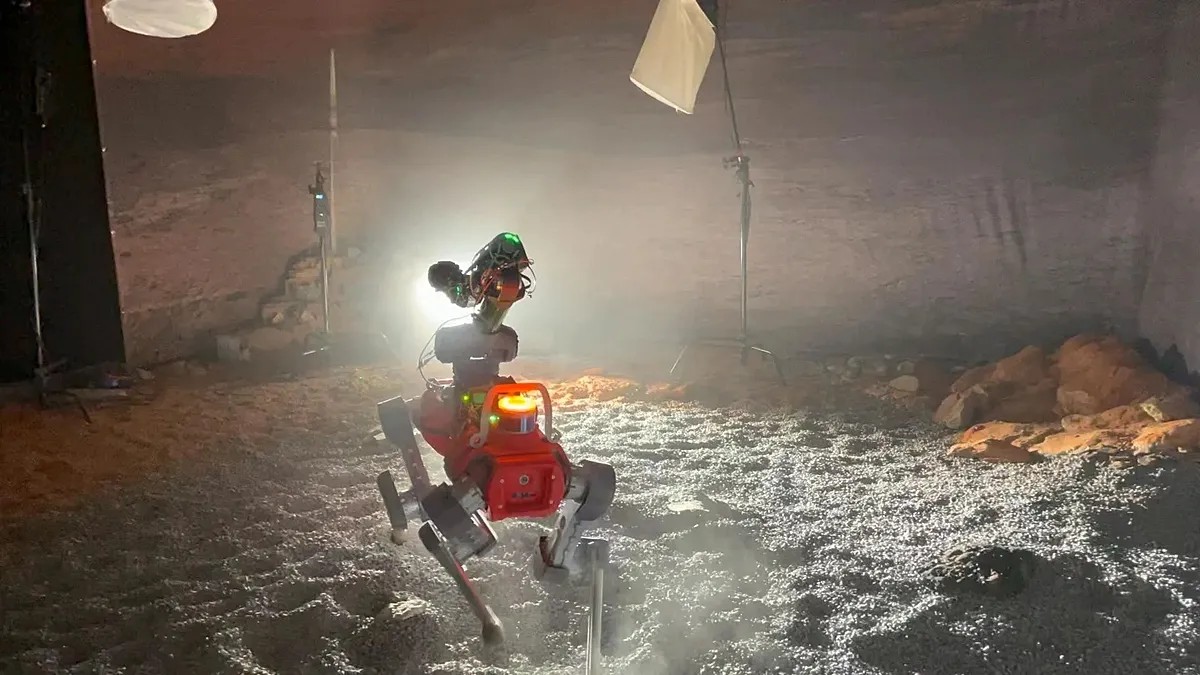
Swiss researchers are testing a new way to explore the solar system: replacing traditional wheeled rovers with semi-autonomous, four-legged robots. By using a robot that can “think” for itself, scientists aim to drastically increase the speed and efficiency of searching for water, minerals, and signs of ancient life on Mars and the Moon.
Meet ANYmal: The Robot Scientist
Unlike the classic, slow-moving wheeled rovers currently used by space agencies, the robot being tested—named ANYmal —resembles a robotic dog. This legged design offers a significant advantage: while wheels can get stuck in soft sand or blocked by large rocks, a legged robot can step over obstacles and navigate much more complex, uneven terrain.
To turn this mobile platform into a scientific tool, researchers have equipped ANYmal with:
– A robotic arm: For precise manipulation of the environment.
– A microscopic imager: To capture high-resolution visual data.
– A Raman spectrometer: A device capable of identifying the unique chemical “fingerprint” of rocks.
The “Marslabor” Trials
Researchers at the University of Basel conducted these tests in a specialized facility known as the “Marslabor.” This simulation environment is designed to mimic the harsh, dusty, and rocky landscapes found on the Moon and Mars.
The goal was to see if the robot could function without a human “leash.” The mission parameters were clear: navigate the terrain independently, locate rocks of scientific interest, analyze their composition, and transmit the data back—all without constant human intervention.
The results, recently published in Frontiers in Space Technologies, were highly successful. ANYmal identified several key materials, including:
– Gypsum (a soft sulfate mineral)
– Carbonates
– Basalts
– Lunar-analogue materials (such as dunite and anorthosite)
Speed vs. Precision: The Human Element
One of the most striking findings of the study was the difference in efficiency. ANYmal completed its scientific missions in just 12 to 23 minutes. In comparison, a human operator performing the exact same tasks took 41 minutes.
However, there is a trade-off to consider. While the robot was significantly faster, the human operator provided slightly more detailed analysis and marginally higher accuracy.
This creates a vital technological question: How much accuracy are we willing to trade for the massive leap in exploration speed?
Why This Matters for Space Exploration
Currently, Mars rovers operate under near-constant supervision from Earth. Because of the communication delay between planets and the need for manual commands, these rovers often move only a few hundred meters per day.
The shift toward autonomous decision-making could change the fundamental nature of space missions. If a robot can decide which rock is worth studying without waiting for instructions from Earth, the pace of discovery could accelerate exponentially.
By combining the mobility of a legged robot with the intelligence of an autonomous scientist, researchers are moving toward a future where machines do more than just follow orders—they actively hunt for biosignatures, the chemical traces that could prove life once existed on other worlds.
Conclusion
The successful testing of ANYmal demonstrates that autonomous, legged robots can outperform humans in speed and terrain navigation. This technology paves the way for much faster, more independent exploration of the Moon, Mars, and beyond.