Traditional downloading is simple. You hit a server. You get a file. The server might slow down if too many people ask for it. Peer-to-peer (P2P) file sharing breaks that model entirely. It doesn’t rely on a central hub. Instead, it turns every participant’s computer into both a client and a server.
The term “peer” sounds professional. It’s really just a regular desktop or laptop. Like yours. The software replaces your web browser as the tool you use to find files. You aren’t asking a corporate data center. You’re asking other people.
Here is the breakdown of the process.
The Mechanics of the Swarm
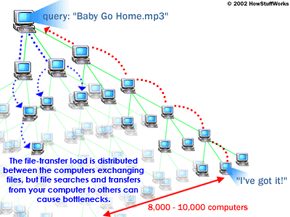
You install a P2P client, such as a Gnutella program. You type in a filename. The software doesn’t just search one place. It broadcasts a query to every other computer in the network running the same protocol.
These connected machines form a mesh.
When the software hits a peer that actually has the requested data on its hard drive, the transfer begins. But it doesn’t stop there. That computer also becomes a source for anyone else searching for the same file. You are pulling pieces of data from multiple sources simultaneously. The load is distributed. It’s supposed to be efficient.
The Bottleneck Problem
In theory, adding more users makes the network faster. In practice, it often creates chaos.
The main issue is bandwidth. Your upload speed is usually much slower than your download speed. If you are downloading a large file, your computer is busy. But if you are also acting as a server for others, you are uploading. This can cause significant bottlenecks. Your connection chokes. The transfers slow to a crawl.
Then there is the human element.
Some users download everything they want and then disconnect immediately. They take the data. They leave. They offer nothing back to the network. This is known as leeching.
When users leech, they drain the network’s resources without contributing to the search or distribution process.
This behavior limits the number of effective computers the software can search. The network shrinks. The efficiency drops. The remaining users suffer.
Why This Matters to You
You might think P2P is just for movies and music. It is. But it’s also used for distributing large software updates, open-source code, and archival data.
Understanding how the protocol works helps you understand why some downloads stall. It’s not always a bad internet connection. It might be the peers themselves.
The technology relies on trust and reciprocity. If everyone leeches, the system collapses. If everyone shares, it thrives. It’s a fragile balance.
For deeper dives into specific protocols, you can look up how Gnutella Works or how Kazaa Works. These older networks laid the groundwork for everything from BitTorrent to modern decentralized storage solutions. The core idea remains the same. You are part of the infrastructure. You always have been.